Free RAID calculator for RAID 0, 1, 5, 6, 10, 50, and 60. Enter drive count and drive size to get usable capacity, number of drives that can fail, and read/write speed multipliers. Instant results for home NAS, workstation, and server builds.
Pick a RAID level, enter the number of drives and drive size, and get usable capacity, fault tolerance (how many drives can fail without data loss), and read / write speed multipliers. Covers RAID 0, 1, 5, 6, 10, 50, and 60 — the levels you'll actually use in home NAS, workstation, and server builds.
RAID configuration
Usable capacity12.00 TB
16.00 TBRaw capacity
25.0%Parity overhead
1Drives can fail
4xRead speed factor
3xWrite speed factor
RAID level comparison at your drive count
Level
Usable
Overhead
Fault tolerance
Min drives
Was this tool helpful?Rate RAID Calculator:5.0(2 ratings)Thanks for rating!
RAID Calculator is a free, browser-based RAID calculator for RAID 0, 1, 5, 6, 10, 50, and 60.
Cost: Free, no signup
Install: None — runs in the browser
Privacy: Runs locally, no uploads
Platforms: Windows, macOS, Linux, Android, iOS
Time: Under a minute
How The RAID Calculator Works
The calculator uses the standard RAID capacity formulas for each level: RAID 0 gives n × D (all drives, zero redundancy); RAID 1 gives D (all drives mirror the same data); RAID 5 gives (n-1) × D (one drive's worth lost to parity); RAID 6 gives (n-2) × D (two drives lost to dual parity); RAID 10 gives (n/2) × D (mirrored pairs then striped). Nested levels like RAID 50 and 60 divide drives into groups, apply RAID 5 or 6 within each group, then stripe across groups. The calculator validates minimum drive counts (3 for RAID 5, 4 for RAID 6, even for RAID 10) and flags invalid configurations instead of silently producing nonsense numbers.
Choosing A RAID Level In 2026
For home and prosumer builds, the conventional wisdom has shifted toward RAID 6 (or its ZFS equivalent, RAIDZ2) for any array built from drives 8 TB or larger. The reason is rebuild time: when a drive fails in a RAID 5 array, the controller has to read every sector on every surviving drive to reconstruct the lost data. On modern high-capacity drives, that rebuild can take 24-48 hours, during which a second drive failure would mean total data loss. With RAID 6's two parity drives, you can survive a second failure mid-rebuild. For sub-8 TB drives and arrays of 4-5 drives total, RAID 5 is still fine; the rebuild window is shorter and the overhead of a second parity drive isn't worth it.
RAID 10 vs RAID 5/6 For Performance
The calculator's speed multipliers tell the story: RAID 10 has a write multiplier equal to n/2 (full speed on each mirror pair, striped across pairs), while RAID 5 has roughly (n-1) × 0.75 and RAID 6 roughly (n-2) × 0.5. The reason is the write penalty on parity RAIDs: a small write requires reading the old data block, reading the old parity, computing new parity, and writing both blocks back — four I/Os for one logical write. For database workloads and VM hosts where random small writes dominate, RAID 10 crushes RAID 5/6 despite using more raw capacity. For sequential workloads (media libraries, backups) the gap closes and parity RAIDs are competitive.
RAID Is Not A Backup Strategy
The single most-repeated piece of storage advice holds: RAID protects against drive failure, not data loss. A ransomware attack encrypts every drive in your array simultaneously; a fire or flood takes them all out; a careless "rm -rf" wipes data from every mirror at once. The 3-2-1 rule still applies on top of any RAID: three copies of important data, on two different media, with at least one off-site. For home setups, a weekly rsync or BackBlaze Personal Backup covers the off-site leg cheaply. For business, cloud backup services (Backblaze B2, AWS S3 Glacier) make the off-site copy essentially free at small scale. Your RAID gets you through a dead disk; your backup gets you through everything else. Power protection is the third leg: an unexpected outage mid-write can leave a parity RAID inconsistent, so estimate UPS runtime for your array and give the NAS enough battery to shut down cleanly.
For drives 8 TB or larger, most storage engineers now recommend RAID 6 over RAID 5. The reason is rebuild time: reconstructing a failed drive from parity can take 24-48 hours on a large array, during which a second drive failure would be catastrophic. RAID 6 tolerates a second failure mid-rebuild.
What is the difference between RAID 10 and RAID 5?
RAID 10 mirrors data across pairs, then stripes those pairs, delivering excellent random I/O performance but consuming 50% of raw capacity. RAID 5 stripes with a single parity drive, giving better capacity efficiency (~83% on 6 drives) but slower writes due to the parity write penalty. RAID 10 for database and VM workloads; RAID 5 for bulk storage.
Does RAID replace backups?
No. RAID protects against physical drive failure within its parity budget. It does not protect against ransomware, accidental deletion, filesystem corruption, fire, flood, or theft - all of which can affect every drive in the array at once. Always maintain separate backups on top of RAID, following the 3-2-1 rule.
What is the minimum number of drives for each RAID level?
RAID 0 and RAID 1 need 2 drives. RAID 5 needs 3. RAID 6 needs 4. RAID 10 needs 4 (and always an even number). RAID 50 needs at least 6 (two groups of 3). RAID 60 needs at least 8 (two groups of 4). More drives give you more capacity and often better performance, but also more opportunities for a drive to fail.
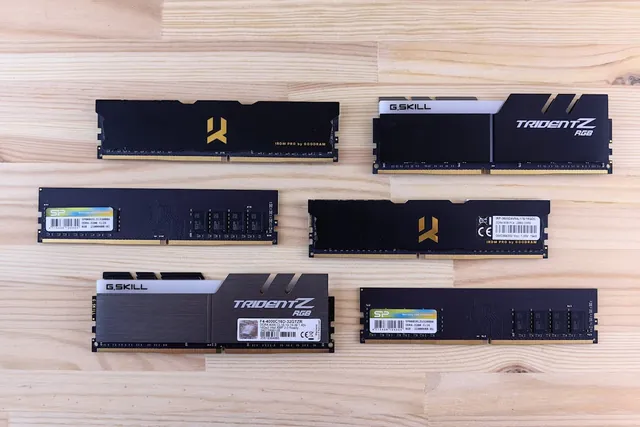
01 / 10DDR5 buying mathPay $120 more for 2 nanoseconds?CL30 vs CL36 looks big on the box. The real difference is 2 nanoseconds.02 / 10What CL really isCAS latency counts cycles, not timeCL is how many clock ticks the RAM waits before answering. Ticks get faster with speed.03 / 10The one-line formulans = 2000 x CL / MT/sTrue latency in nanoseconds. DDR5-6000 CL30: 2000 x 30 / 6000 = 10.0 ns.04 / 10CL30 vs CL36 at 600010.0 ns versus 12.0 nsSame speed, different CL: the whole debate is about 2 nanoseconds of wait time.05 / 10The tie surprise7200 CL36 is also 10.0 nsSo is 6400 CL32. A higher CL on a faster kit can match a lower CL exactly.06 / 10What 2 ns buys in gamesRoughly 1-4% average FPSOnly when CPU-bound, and benchmarks disagree. Smoother 1% lows are the steadier win.07 / 10Price check, Aug 11, 2026The CL30 premium: $120G.Skill CL30 $599.99 vs CL36 $479.99. A Patriot CL30 kit: $429.99. Shop across brands.08 / 10The EXPO/XMP gotchaYour CL30 may be running CL40Kits boot at JEDEC defaults until you enable EXPO or XMP in BIOS. Check yours today.09 / 10The X3D exceptionBig cache blunts CLOn 7800X3D-class CPUs, the stacked cache blunts CL gains. Buy CL36 and save.10 / 10The verdictSmall delta: yes. Upgrade: no.Compare your two kits in real nanoseconds - presets loaded, math done for you.
01 / 10Phone vibration testYour phone stopped buzzingBefore you book a repair, find out whether it is the motor or just a setting.02 / 10The symptomMissed calls and silent alertsA dead motor is easy to miss. You only notice the calls you never felt arrive.03 / 10What is insideA tiny weight on a motorMost phones spin an offset weight or drive a linear actuator to make the buzz.04 / 10Check this firstSettings fake a dead motorSilent mode, Do Not Disturb and per-app vibration all switch the buzz off.05 / 10Run the testOne tap, three patternsThe browser asks the phone to vibrate in short, long and pulsed patterns.06 / 10Result: weakYou feel it, but barelyA faint buzz often means a loose motor mount or a case damping the vibration.07 / 10Result: nothingNo buzz on any patternWith settings ruled out, silence points at the motor or its connector.08 / 10Result: on and offIt works, then it does notIntermittent buzzing usually means a failing solder joint or a worn motor.09 / 10One honest limitiPhones cannot run this testSafari on iOS does not support the browser vibration API, so use Android.10 / 10Your turnFind out in thirty secondsRun the three patterns, then decide whether it is a setting or the hardware.