



You post consistently. Content is good (you think). But nothing happens. No engagement. No followers. No traction. You blame algorithm. You blame platform. You blame audience. But real reason is different. Real reason is diagnostic. You are solving wrong problem. Most creators are solving wrong problem. They blame surface-level factors. But real reason is usually deeper. Real reason is usually one of five root causes. Identify root cause. Fix root cause. Content gets traction. This is how creators who win actually think. They diagnose. They do not assume.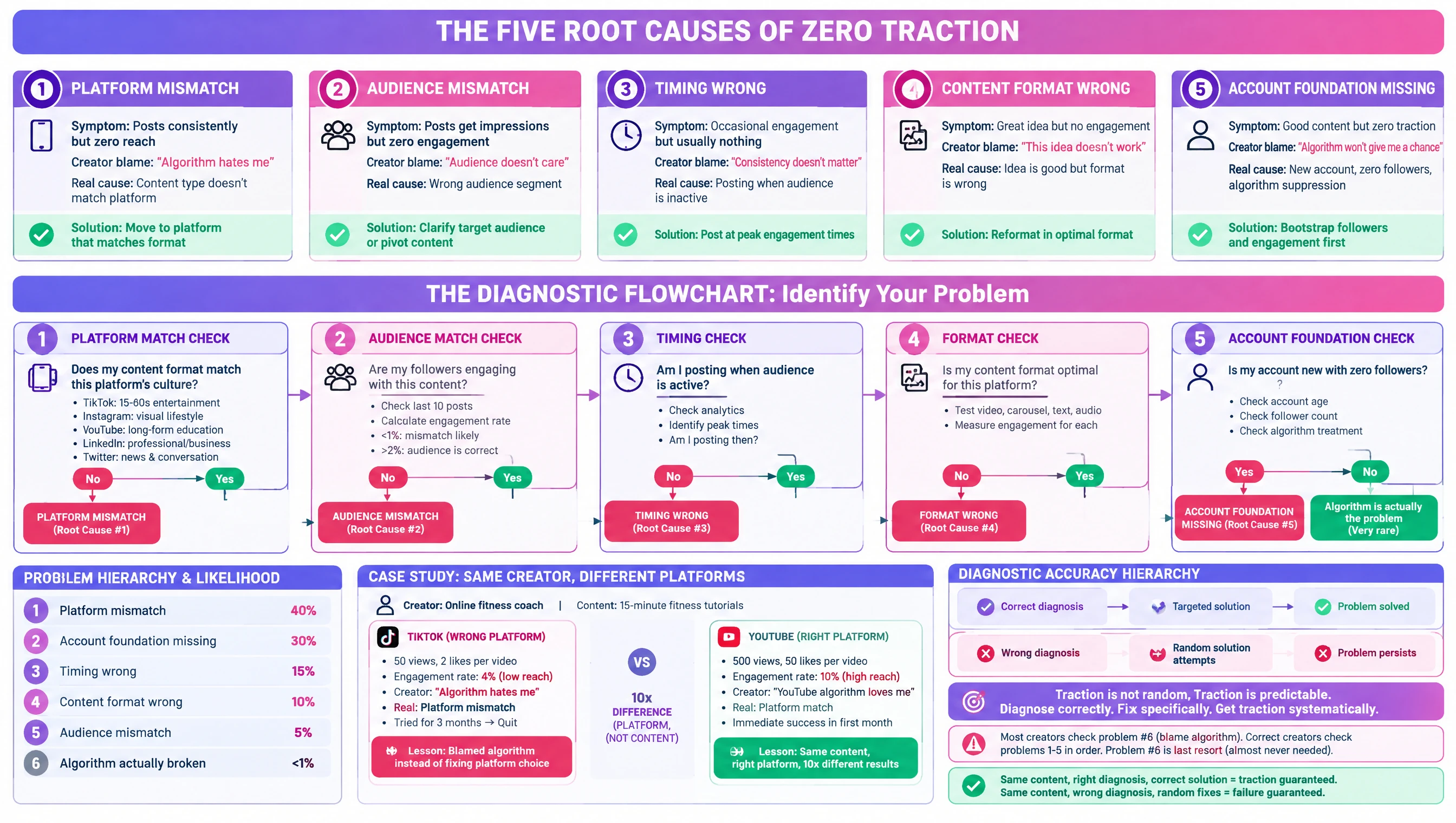
The Five Root Causes of Zero Traction (And How to Identify Which One Is Yours)
Root Cause #1: Platform Mismatch (You Are On Wrong Platform for Your Content Type)
Symptom: You post consistently but get zero reach. You think algorithm is broken. Real cause: Your content type does not match platform algorithm. Example: You create long-form educational content. You post on TikTok (platform built for short-form entertainment). Algorithm will not amplify educational long-form on TikTok. Algorithm amplifies 15-60 second entertainment. Your educational content fails. Not because content is bad. Because platform is wrong. Real solution: Post same content on YouTube (built for long-form) or LinkedIn (built for educational). Content gets traction immediately.
Diagnostic question: Does my content type match this platform's content culture? If no, platform is wrong. Switch platforms or reformat content for platform.
Root Cause #2: Audience Mismatch (Your Content Reaches Wrong Audience)
Symptom: Posts get impressions but zero engagement. Audience sees content but ignores it. Real cause: Your content appeals to audience segment that is not on your profile. Example: You create fitness content aimed at athletes. Your audience is mostly 45-year-old women interested in wellness (not athletic performance). Content is good but does not match audience interests. Audience ignores content. Not because content is bad. Because audience is wrong. Real solution: Clarify target audience. Create content for actual audience (wellness-focused, not performance-focused). Content gets engagement immediately.
Diagnostic question: Does my content appeal to people currently following me? If no, audience is wrong. Either attract right audience or pivot content to match current audience.
Root Cause #3: Timing and Posting Strategy (You Post When Audience Is Not Active)
Symptom: Content occasionally gets engagement but usually gets nothing. You post randomly. Real cause: You post when audience is inactive. Algorithms favor recency. Post at 2 AM when audience sleeps = algorithm gives you 2 hours of reach (then post gets buried). Post at 9 AM when audience wakes up = algorithm gives you 6-8 hours of reach (post stays visible longer). Time matters. Real solution: Post when audience is most active. Monitor analytics. Identify peak engagement times. Post consistently at peak times. Same content, different timing, 10x different engagement.
Diagnostic question: When is my audience most active? Am I posting then? If no, timing is problem. Change posting schedule. Test different times. Find peak times.
Root Cause #4: Content Format Problem (Your Idea Is Good But Format Is Wrong)
Symptom: Your idea seems great but gets no engagement. Real cause: Idea is good but format is wrong for platform. Example: You have great insight. You post as text caption (1,000 words). Platform algorithm suppresses long captions. Real solution: Reformat same insight as carousel (visual format). Same idea, visual format instead of text, 5x higher engagement. Format matters more than idea quality sometimes.
Diagnostic question: Am I using optimal content format for this platform? Video, carousel, text, audio? If unsure, test multiple formats. Measure engagement. Use winning format.
Root Cause #5: Insufficient Engagement Infrastructure (New Account With Zero Foundation)
Symptom: You post good content but zero traction. Real cause: You have no engagement infrastructure. New account (zero followers) gets algorithm suppression. Suppression limits reach. Limited reach = zero engagement. Problem is not content. Problem is account age and bootstrap status. Real solution: Bootstrap followers + buy engagement on first posts. Create engagement infrastructure. Then post content. Same content on bootstrapped account gets 10x more reach than content on zero-follower account.
Diagnostic question: Is my account new with zero followers? If yes, bootstrap infrastructure is problem. Invest in engagement bootstrap first. Content comes second.
Diagnostic Framework: Which Root Cause Is Yours?
Step 1: Check Platform Match
Question: Does my content type (length, format, style) match this platform's content culture? TikTok = short-form entertainment. Instagram = visual lifestyle. YouTube = long-form education. LinkedIn = professional/business. Twitter = conversation/news. Mismatch = platform wrong. If mismatch, switch platforms or reformat content. Do not blame algorithm. Blame platform choice.
Step 2: Check Audience Match
Question: Do people currently following me engage with this content? Look at engagement rate. If engagement rate is below 1%, audience mismatch is likely. Look at who is engaging. Are they your target audience? If not, audience is wrong. Do not blame algorithm. Blame audience targeting.
Step 3: Check Timing
Question: Am I posting when audience is active? Check analytics. Identify when audience is online. Am I posting then? If not, timing is problem. Post same content at peak times. Measure results. If engagement improves 3-5x, timing was problem. Do not blame algorithm. Blame posting schedule.
Step 4: Check Content Format
Question: Is my content format optimal for this platform? Test multiple formats (video vs carousel vs text vs audio). Measure engagement. If certain format gets 3-5x better engagement, format was problem. Do not blame algorithm. Blame content format choice.
Step 5: Check Account Foundation
Question: Is my account new with zero followers? If yes, engagement infrastructure is problem. Bootstrap followers. Buy engagement on first posts. Then post content. If engagement improves 5-10x, bootstrap was problem. Do not blame algorithm. Blame account foundation.
The Real Truth: Algorithm Is Rarely The Problem
Creators Blame Algorithm When Real Problem Is Them
Creators say: "Algorithm will not show my content." Reality: Algorithm will show your content if it matches platform, matches audience, matches timing, matches format, and account has foundation. If any of these five factors is wrong, algorithm suppresses (by design). This is not algorithm failure. This is algorithm working correctly (filtering out mismatched content). Creator failure to optimize is blamed on algorithm. This is cognitive error.
Algorithm Precision: Why It Ignores Bad Decisions
Algorithm is precise. Algorithm knows: Does this content match this audience? Algorithm measures platform relevance, audience interest, timing alignment, format compatibility. If any metric is wrong, algorithm filters content. Algorithm is not being mean. Algorithm is being accurate. Algorithm is doing job correctly. Creators misinterpret accuracy as sabotage.
Case Study: Same Creator, Different Results (Platform Mismatch Example)
Creator: Fitness Coach (Online)
Posted 15-minute fitness tutorials. Platform: TikTok. Results: 50 views, 2 likes per video. Blamed algorithm: "TikTok algorithm hates me." Tried for 3 months. Zero growth. Quit. Reality: 15-minute video does not match TikTok format (optimal: 15-60 seconds). Algorithm suppressed long-form content (correctly). Creator blamed algorithm (incorrectly).
Same Creator On YouTube
Posted exact same 15-minute tutorials. Platform: YouTube. Results: 500 views, 50 likes per video. 10x higher engagement. Why? Because YouTube algorithm rewards long-form educational content. Same content. Different platform. 10x different results. Problem was not content. Problem was platform choice.
Lesson: Diagnostic Accuracy Matters
Creator diagnosed wrong (blamed algorithm). Creator implemented wrong solution (tried harder on TikTok). Creator quit before finding right platform. Real solution: Switch to platform that matches content. Same content, right platform, massive traction.
The Hierarchy of Problems (In Order of Likelihood)
If Content Gets Zero Traction, Check Problems In This Order:
Problem 1 (40% likelihood): Platform mismatch. Check first. Switch platforms if needed.
Problem 2 (30% likelihood): Account foundation missing. Check second. Bootstrap if needed.
Problem 3 (15% likelihood): Timing wrong. Check third. Change posting schedule if needed.
Problem 4 (10% likelihood): Content format wrong. Check fourth. Test formats if needed.
Problem 5 (5% likelihood): Audience mismatch. Check fifth. Clarify target audience if needed.
Problem 6 (Very rare): Algorithm actually broken (extremely unlikely). Check last. Only if all five above are correct.
Most creators check problem 6 first (blame algorithm). This is diagnostic error. Correct approach is check problems 1-5 in order. Problem 6 should be last resort (almost never is real problem).
Quick Diagnostic Test (5 Minutes to Identify Your Problem)
Question 1: Does your content type match platform?
TikTok user making 15-min videos? No match. YouTube user making 15-min videos? Match. Which platform are you on? Does content match?
Question 2: Are followers engaging when they see content?
Look at last 10 posts. What is engagement rate? Below 1% = audience mismatch likely. Above 2% = audience is okay.
Question 3: When is your audience online?
Check analytics. When do most people follow you, see your posts, engage? Are you posting then? If not, timing is problem.
Question 4: Have you tested different content formats?
Posted video? Posted carousel? Posted text? Which got highest engagement? Use winning format going forward.
Question 5: Does your account have foundation?
Zero followers? New account? Bootstrap is needed before expecting traction. Have you bootstrapped? If not, this is problem.
If answers reveal problem, fix that specific problem. Do not blame algorithm. Do not try random solutions. Fix specific diagnosed problem. Traction follows.
The Real Insight: Traction Is Not Random
Traction feels random (when you do not diagnose). Traction feels like algorithm luck (when you ignore root causes). But traction is actually predictable. Traction follows from correct diagnosis and implementation. Correct platform + correct audience + correct timing + correct format + correct foundation = predictable traction. Most creators skip diagnosis. Most creators blame algorithm. Most creators quit. Smart creators diagnose. Smart creators fix root cause. Smart creators get traction.
Content traction framework is available in platform-specific content optimization services. Diagnostic approach is platform-dependent. Each platform has different root cause likelihoods. Instagram content optimization and engagement bootstrap addresses platform-specific issues. Complete diagnostic framework and platform implementation guides available in comprehensive strategy hub. Diagnose correctly. Fix specifically. Get traction predictably. This is how creators who win actually think and operate.



Reader discussion
Comments
Share what worked, what did not, or what you would test next. Every comment is reviewed before it appears.
Loading approved comments…
Leave a comment
No account or sign-in is required. Links and HTML are not accepted.