










Quick answer
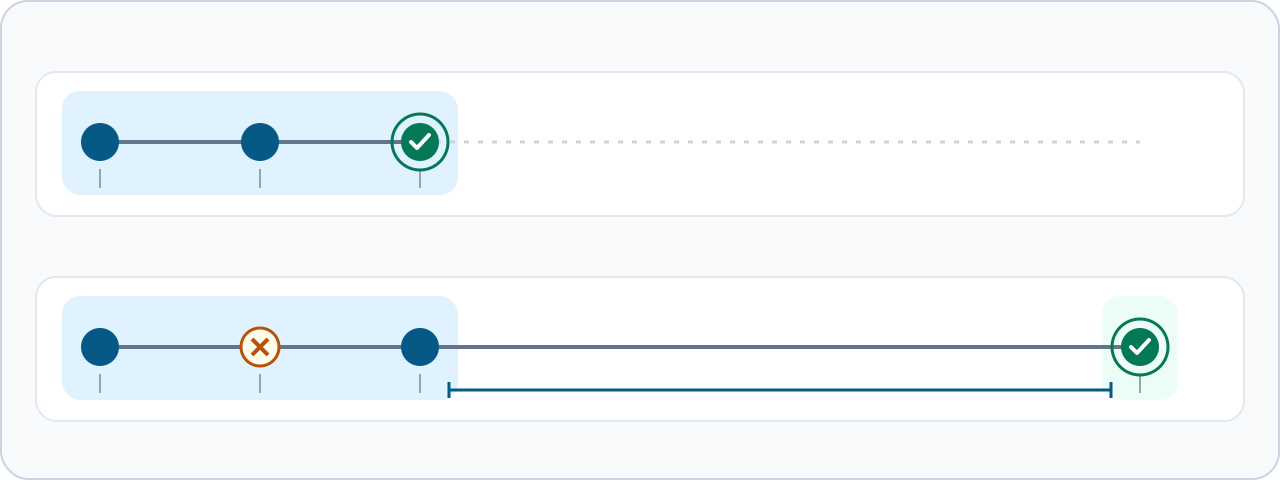
A burst weapon can have the shorter ideal TTK and still take longer after one miss. If the missing damage forces a new burst, you wait through the burst gap before another shot can finish the target. In our fictional comparison, the burst weapon wins at 133.3 ms versus 300 ms with every shot landing, but loses at 433.3 ms versus 400 ms when each weapon misses once.
The penalty depends on where the kill falls in the firing pattern. It is not always an entire burst, and a miss after the killing shot cannot change TTK.
Burst-fire TTK becomes useful when you can see the individual shots behind the number. A low ideal result hides a question that matters during a comparison: what happens if one of the shots needed for the kill deals no damage, hits a limb, or empties the magazine?
We will change one condition at a time and reproduce the results in the shot-by-shot TTK calculator. These are invented weapon configurations, not live stats for Battlefield, Call of Duty or any other game. For the basic distinction between damage per second and time to kill, start with why higher DPS can still mean a slower kill.
Start with two weapons against the same target
Use 100 HP, no extra shield, no armor reduction, 100% range damage and one pellet per shot for both weapons. Every body hit uses a 1× multiplier. Unlimited ammunition is enabled until the reload example.
| Input | Burst weapon A | Automatic weapon B |
|---|---|---|
| Body damage per shot | 34 | 26 |
| Fire rate | 900 RPM inside each burst | 600 RPM continuously |
| Firing pattern | 3 shots per burst | Full auto |
| Gap after a burst | 300 ms, from its last shot to the next burst’s first shot | No separate burst gap |
| Body hits needed | 3: 34 + 34 + 34 = 102 | 4: 26 × 4 = 104 |
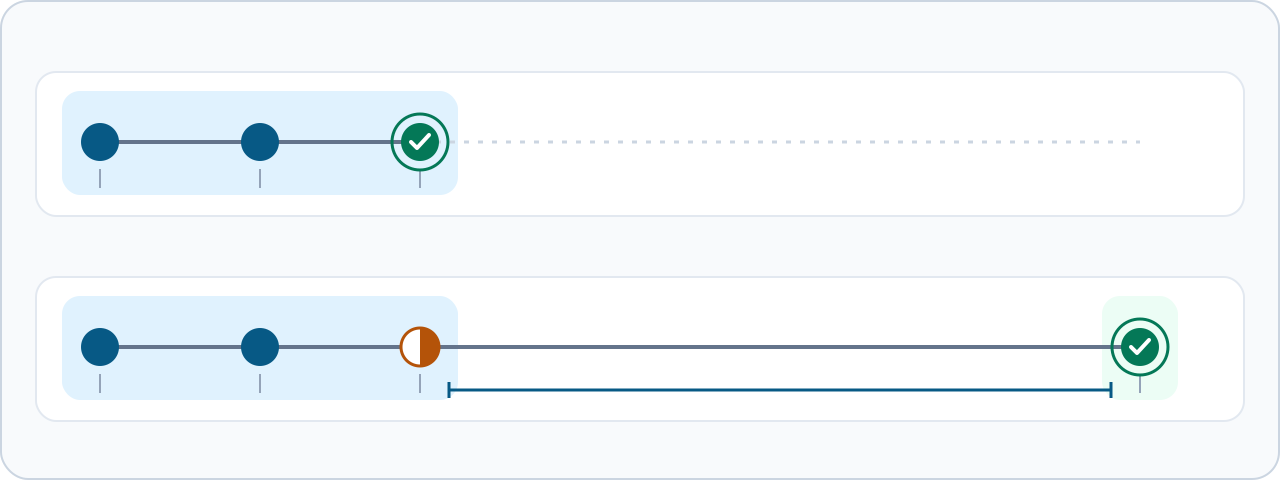
Weapon A fires at 0, 66.7 and 133.3 ms, then at 433.3 ms. Its 300 ms gap replaces the normal shot interval at that boundary; it is not an extra delay added after another interval. Weapon B fires at 0, 100, 200, 300 and 400 ms.
Here, a burst is a configured fixed firing pattern. Manually tapping a full-auto gun is a different timing problem: enter the actual cadence if you want to model it. All examples begin with a successful first shot at 0 ms and omit trigger, travel and networking delays.
One miss reverses the winner
With every required shot landing, A kills on shot three at 133.3 ms. B needs shot four at 300 ms. Now change the second fired shot to a miss for each weapon. Do not change the damage, target or fire rate.
| Weapon and condition | Fired sequence through the kill | TTK |
|---|---|---|
| A, all hits | Body → body → body | 133.3 ms |
| B, all hits | Body → body → body → body | 300 ms |
| A, one miss | Body → miss → body → body | 433.3 ms |
| B, one miss | Body → miss → body → body → body | 400 ms |
A has dealt only 68 damage after the first burst. Its next body hit must wait until 433.3 ms. B reaches 104 damage with its fifth fired shot at 400 ms, so B now finishes 33.3 ms sooner. Under these inputs, the miss adds 300 ms for A and 100 ms for B.
The useful conclusion is conditional: a weapon that relies on a clean lethal burst may lose its advantage when one required hit fails. This does not prove full auto is better in every game. Different health, damage, firing gaps or hit patterns can produce a different result.
Load A with its missed second shot, then try the matching full-auto sequence. The links load the setup; they do not silently add it to your saved library.
A limb hit can cross the same boundary without a miss
Return to weapon A and set its limb multiplier to 0.5×. Body damage remains 34; one limb hit now deals 17. This multiplier is a fictional comparison setting, not a universal rule for limbs.
Three body hits deal 102 damage and finish at 133.3 ms. A body → body → limb burst deals 34 + 34 + 17 = 85. All three bullets hit, but the target still has 15 HP. Add a body hit at the start of the next burst and the kill moves to 433.3 ms.
The lesson is about a damage threshold, not just accuracy percentage. Both patterns can have 100% of fired shots landing, yet different hit locations change the result. Reproduce the mixed body-and-limb sequence instead of substituting an average damage value and assuming it describes this exact fight.
Real hit-region rules vary. In its June 2026 gunplay explanation, Battlefield’s developers discuss changing body-part multipliers to distinguish average outcomes from the best possible TTK. That supports checking the actual game and patch; it does not make our sample values Battlefield statistics.
A missed shot can also force a reload
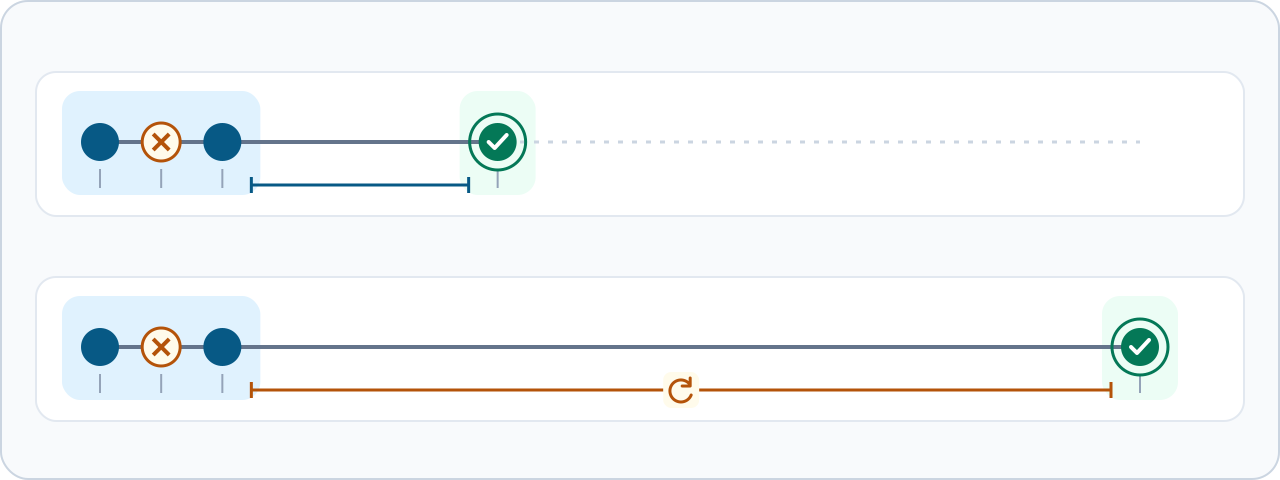
Keep A’s body → miss → body → body sequence. Now compare a four-round magazine with a three-round magazine. In both cases, enter a 1,000 ms reload delay measured from the last fired shot in the empty magazine to the first shot after reloading.
| Magazine capacity | What happens after shot three? | Kill time |
|---|---|---|
| 4 rounds | Wait the normal 300 ms burst gap; one round remains | 433.3 ms |
| 3 rounds | The magazine is empty; wait 1,000 ms and start a fresh burst | 1,133.3 ms |
The third shot fires at 133.3 ms. With three rounds available, the next shot arrives at 133.3 + 1,000 = 1,133.3 ms. Do not add another 300 ms burst gap: this calculator replaces the boundary interval with the supplied reload delay.
A missed shot still consumes ammunition. Conversely, if all three shots had landed, the third would have finished the target. The calculation would stop there; it would not add a reload after the kill. Open the three-round reload example and change magazine capacity to four to see the boundary move.
Real empty-reload and partial-reload timings can differ. Use the timing that matches your situation; this model does not simulate separate reload-animation stages or ammunition already missing from a partially used magazine.
Reproduce the comparison, then save your own setups
- Fix the target first. Open the weapon comparison calculator and enter the same HP, shield, armor and range assumptions for both guns. A faster result against a weaker target is not a fair comparison.
- Enter the firing pattern. For A, use damage 34, 900 RPM, burst size three and a 300 ms last-shot-to-next-first-shot gap. For B, use damage 26, 600 RPM and continuous fire.
- Check the clean baseline. The body result should be 133.3 ms for A and 300 ms for B. Save both configurations under clear names; the library can hold up to 30 setups in this browser.
- Use the comparison table for identical hit regions. Pin a setup or select a saved gun. Check that the current target conditions are the ones you intended. The four-region table assumes every shot hits its selected region.
- Use Mixed hits and misses for the exact sequence. Enter body, miss, body, body for A and one extra body hit for B. Run each explicit sequence separately; the four-region comparison does not apply that mixed sequence to both guns.
- Change one variable and keep the evidence. Try the limb multiplier or magazine boundary, then copy a setup link. Download the library as JSON if you want a backup before clearing browser storage or moving devices.
A shared link loads inputs and the explicit sequence. It is not a cloud account or automatic synchronization of your saved library. If storage is unavailable, keep the setup link or download instead of assuming the save persisted.
Use the result to ask a better question
Instead of asking which gun has the lowest headline TTK, ask: does its advantage survive the hit pattern and magazine boundary I am comparing? A useful small test is the clean sequence, one miss before the kill, and one lower-damage hit. Keep the target constant and record when the ordering changes.
The result can show
The kill time of the exact sequence under your supplied damage and timing rules; how a burst boundary, hit region or reload changes it.
The result cannot show
How often you will land that sequence, how controllable the recoil feels, or which weapon will win an actual match.
“One miss” is a scenario, not an accuracy distribution. Do not turn these examples into an expected TTK at a claimed hit rate. If your sequence starts with a miss, the sequence clock still starts at that first fired round; label that differently from a first-landed-hit convention.
Projectile travel, charge-up, shield-break effects, healing, penetration, game-specific rounding and network delay are outside this model. Epic’s Shooter Game documentation distinguishes instant-hit and projectile processing; a damage timeline alone cannot stand in for the complete input-to-impact path.
A pointer-control check, simple visual reaction test or browser frame-rate check can explore a separate part of your setup. None measures your in-game hit probability or adds a measured latency correction to these weapon timings. If aiming feels different between games, compare the camera assumptions using our guide to matching field of view.
Keep these measurements separate when interpreting a result: our aim-trainer score guide explains time per target, reaction time and accuracy percentage, while the gaming reaction-time guide explains what a stimulus-to-click result includes. Neither score is the weapon-only timeline calculated here.
Background: why gunplay involves more than ideal TTK
Battlefield’s official gunplay discussion covers weapon handling and damage design. It provides game-specific context, not verification of our fictional guns or a current all-weapons stat chart.

Burst-fire TTK questions
Does one missed shot always add a whole burst?
No. It matters whether the extra required shot crosses a burst boundary. In this example the clean kill ends on shot three, so one miss moves it to the next burst. Other damage and health values can keep the kill inside the same burst.
Is burst delay measured between burst starts?
For this calculator, enter the gap from the last shot of one burst to the first shot of the next. It replaces the ordinary shot interval at that boundary. A start-to-start burst-cycle value includes the time spent firing the earlier shots and must be converted before use.
Why does a limb hit sometimes increase TTK?
If its lower damage leaves the target alive at the end of the otherwise lethal sequence, another shot is required. Whether that means a short interval, a burst gap or a reload depends on the firing pattern and magazine state.
Does the two-gun table include my mixed-hit sequence?
No. Its four-region results assume all shots hit one selected region. Use Mixed hits and misses to calculate each explicit sequence, and compare those results separately under the same target conditions.
Does the reload delay get added to the burst gap?
Not in this model. At an empty-magazine boundary, the entered last-shot-to-next-shot reload delay replaces the normal interval or burst gap. The next magazine begins a fresh burst, and no reload is counted after the killing shot.
Are the presets and examples current game weapon stats?
No. These article examples are fictional and the tool’s presets are illustrative starting points. Use verified values for your game version and state any simplifications. The result is a model calculation, not a measurement of a real match.
Method: fictional weapon inputs checked against KBT’s calculator and independent shot-timeline arithmetic. Results are rounded to one decimal place for display. Stock photography is illustrative; the diagrams explain the model. No real-game weapon benchmark is claimed.
Sources and method
Technical context was checked on September 27, 2026. The linked calculator lets you reproduce the article’s model examples.
Compare the sequence you actually want to test
Start with a clean baseline, add one miss, and keep the target the same. Save or share the setup once you can explain why its kill time changed.
Try the TTK calculator


Reader discussion
Comments
Share what worked, what did not, or what you would test next. Every comment is reviewed before it appears.
Loading approved comments…
Leave a comment
No account or sign-in is required. Links and HTML are not accepted.