









WEB DEVELOPMENT · PRACTICAL GUIDE
Understand where routing ends, rendering begins, and data extraction still needs your attention.
A price-monitoring script can finish without an error and still save the wrong result. It might capture an empty JavaScript shell, a regional price with the wrong currency, or a product page whose discount has already expired. Solving those problems starts with understanding which part of the collection process needs help.
For the routing layer, Floppydata offers residential proxies using home-broadband IP addresses, with rotation and sticky-session options. Its separate web scraping API is aimed at managed page retrieval and JavaScript rendering. These services address different parts of a workflow: a proxy supplies a network route, while the API delivers page content for your application to process.
This distinction matters for developers checking public product information, comparing regional storefronts, or maintaining a small research dataset. The most useful setup is the one that produces the required information reliably, at a cost and maintenance level your team can support.
1. Separate routing, rendering and extraction
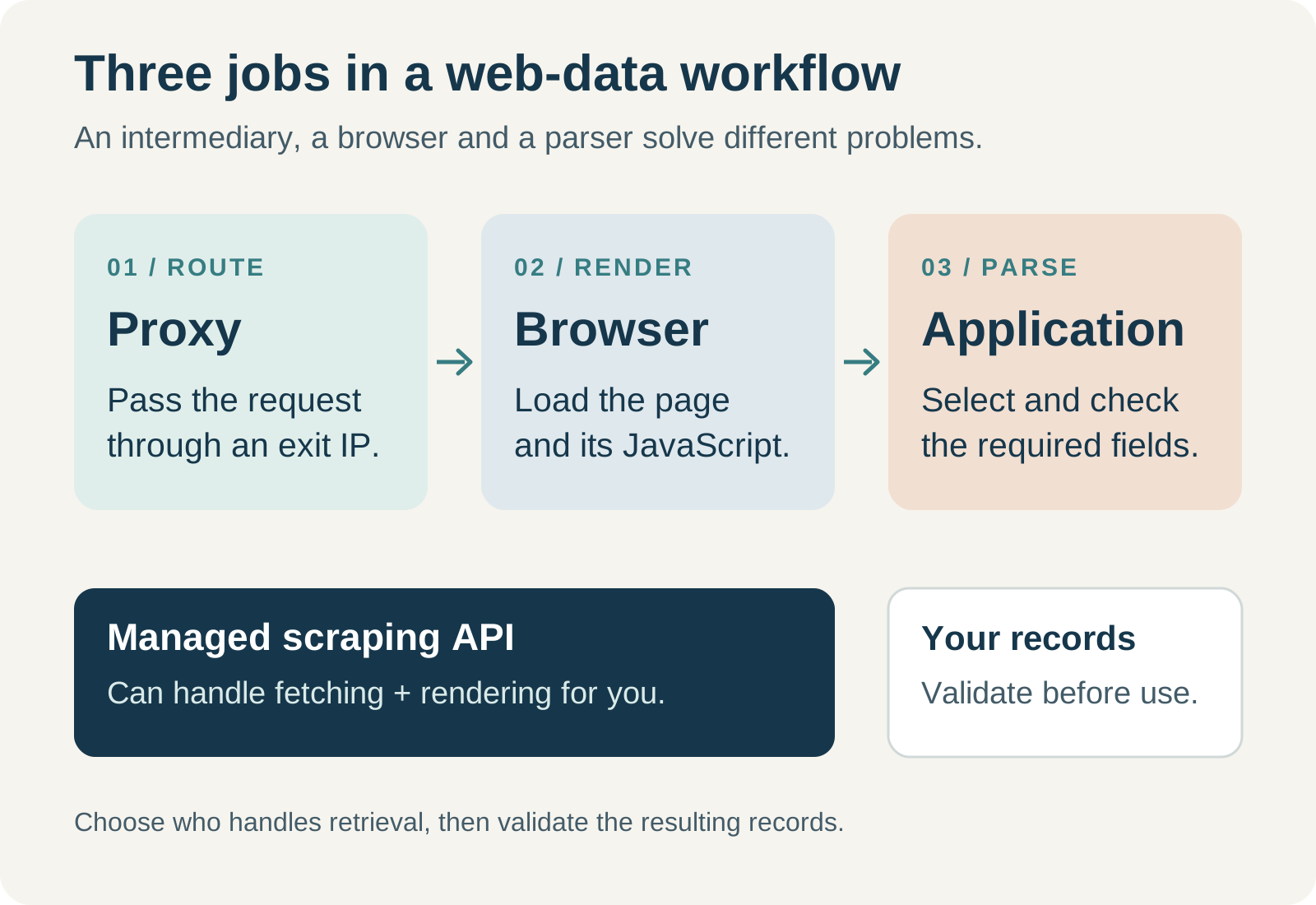
Think of web data collection as three connected tasks.
- Routing: your client connects to the destination, either directly or through an intermediary. A proxy changes that connection path and the IP address the destination sees.
- Rendering: a browser runs page scripts and builds the visible document. This matters when the initial HTML does not contain the information you need.
- Extraction: your code identifies the relevant fields, normalizes them and decides whether to accept the result.
A proxy alone does not execute JavaScript. If a storefront loads prices after the first response, routing an ordinary HTTP request through a residential exit does not automatically produce those prices. You still need a suitable browser workflow or a service that performs the rendering step.
Rendered HTML also needs interpretation. A page may contain a regular price, a sale price, a financing installment and a price for a different variant. Receiving all of that markup is useful, but deciding which number belongs in a price-history record remains an application-level job.
2. What a residential proxy changes
A residential proxy sends traffic through an exit associated with a residential internet connection. Datacenter proxies use hosting infrastructure; mobile proxies use mobile-network exits. These categories describe the network connection, rather than a guarantee about how a website will respond.
A residential route can be relevant when testing location-dependent public content. For example, a storefront may display different shipping information by region. Keep other variables consistent while investigating: language settings, cookies, account state and currency controls can also change the page. An IP address is only one input to the experience.
Floppydata's residential offering advertises HTTP, HTTPS and SOCKS5 connections, regional targeting and session controls. Check the connection format and location availability against your actual client before building a larger job. A proxy endpoint is not interchangeable with a scraping API endpoint, and their authentication and usage models can differ.
A proxy also does not make a session anonymous. Accounts, cookies and other browser signals can still identify activity. It should be selected for an appropriate routing requirement, with clear permission for the work being performed.
Rotating, sticky and static are different choices
Rotation changes the exit IP between requests or sessions, depending on the configuration. A sticky session attempts to keep the same exit for a sequence of requests. A static proxy is intended to retain the same assigned exit IP; it should not be assumed to be the same product as a temporary sticky session.
For a multi-step regional check, consistency may matter more than frequent rotation. Record the session configuration with the result, and avoid changing both the route and the browser state halfway through the same comparison.
3. What a managed scraping API takes off your plate
Running a browser yourself means maintaining more than a request function. You may need to handle browser versions, startup and shutdown, navigation failures, waiting conditions, resource usage and job recovery. A managed retrieval API moves part of that operational work to the provider.
Floppydata's current Web Data documentation describes a fetch operation that returns a JSON response containing html, sourceUrl and fetchedAt. The page-content payload is rendered HTML. That is different from receiving a ready-made product record with a normalized name, price and availability field.
The documented fetch request requires a URL and supports optional location and cache settings. For time-sensitive monitoring, the guide documents cacheMaxAgeDays: 0 for fresh retrieval. Treat that as a request setting, then inspect the returned content: a fresh fetch does not prove that the originating website has just updated its information.
If you need a long sequence of clicks, state changes or interactive debugging, check whether a browser-automation product fits better than a single-fetch API. Floppydata markets a separate cloud-browser service; a proxy, a managed fetch API and an interactive browser session should not be treated as identical tools.
4. Compare the setups by the work you need to do
| Your requirement | Your client with a proxy | Managed fetch API |
|---|---|---|
| Choose the network route | You configure the proxy and session behavior. | You use the provider's supported retrieval and location options. |
| Run page JavaScript | You provide a browser when the page requires it. | Rendering is handled by the service, within its documented capabilities. |
| Control a multi-step interaction | Your browser code controls clicks, state and navigation. | Confirm that the API supports the required actions; a fetch endpoint may not. |
| Extract reliable fields | You write and maintain the extraction rules. | For an HTML-returning API, you still write those rules. |
| Investigate a failure | You can inspect your own client, browser and routing logs. | You depend partly on the response details and diagnostics the service exposes. |
| Estimate operating cost | Include traffic, compute, browser upkeep and engineering time. | Include API usage, parsing, validation and storage. |
Neither approach removes maintenance entirely. A managed API can reduce retrieval work, while a self-managed client can give you more direct control. In both cases, a website redesign can break selectors or change the meaning of a field.
5. Build a useful product-monitoring workflow
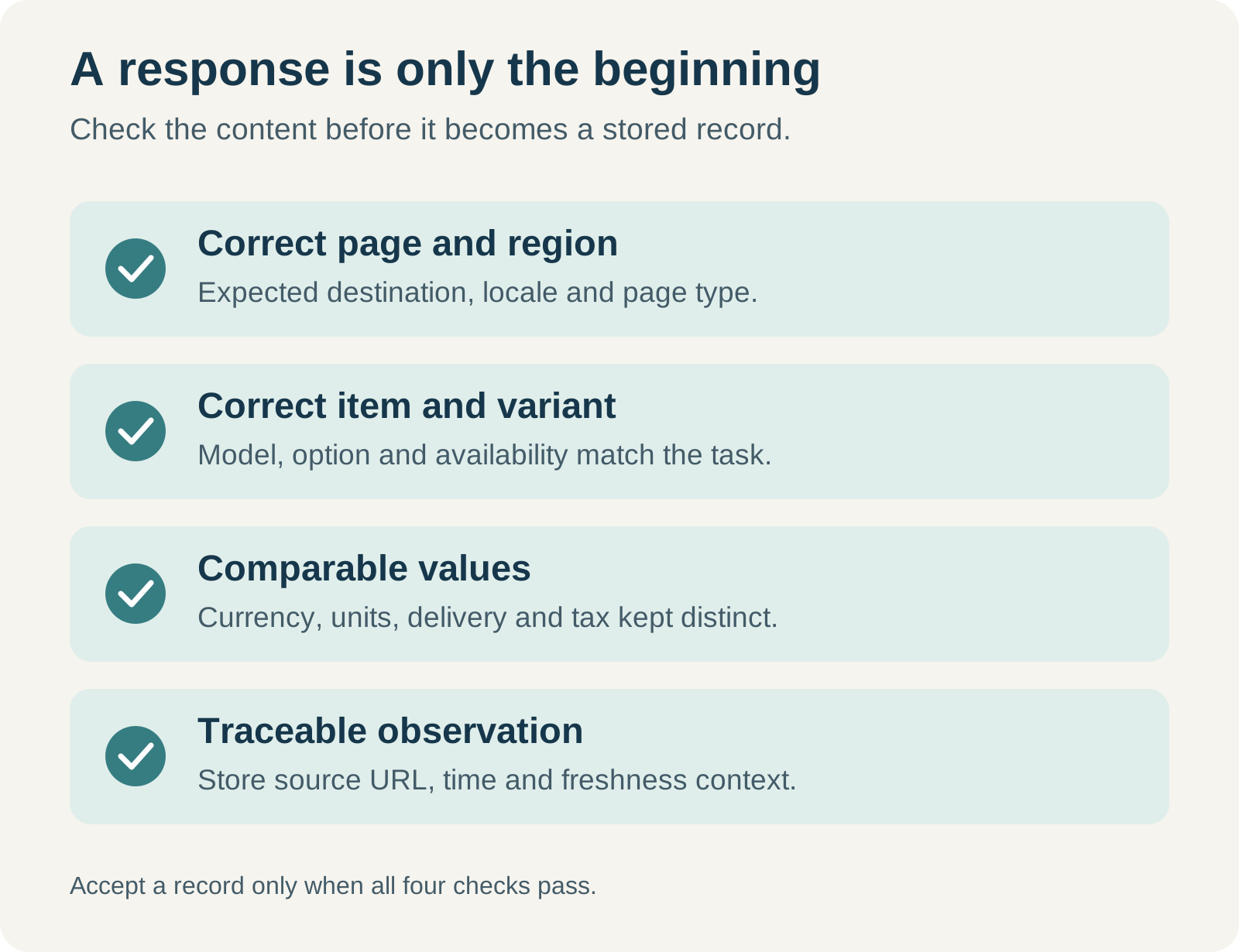
Start with a small, permitted sample of public pages. Define the fields before choosing infrastructure: for example, product identifier, selected variant, displayed price, currency, stock status, source location and retrieval time.
- Set the comparison conditions. Choose the intended country, language and variant. Decide how to handle member-only offers, tax wording and shipping costs so you do not compare different kinds of prices.
- Inspect the simplest response first. If the required information is already in the HTML, a full browser may add complexity without helping. If it appears only after scripts run, test a rendering approach.
- Retrieve and preserve enough context. Keep the source identifier, timestamp and relevant response details. Store raw content only where permitted and needed for debugging, with a defined retention period.
- Extract explicit fields. Keep the amount and currency separate. Distinguish an unavailable value from a zero value, and distinguish a missing stock label from confirmed availability.
- Validate before updating history. Check that the expected product and variant are present. If the response is an access notice, empty layout or unrelated page, flag it instead of saving it as a valid observation.
- Review unusual changes. A sudden price drop might be a real offer, but it might also be an installment amount or a parser error. Preserve a reason for accepting or rejecting the observation.
This process makes infrastructure comparisons meaningful. A fast response that lacks the required fields is not a successful data record. A slower response may be more useful if it consistently returns the correct item and enough context to verify it.
6. Measure useful output and total cost
Compare both approaches on the same representative sample and record why each result passed or failed. Keep different problems separate: connection errors, rendering failures, missing fields, wrong variants and stale observations call for different fixes.
Also record completion time and how much manual investigation the run required. A low headline traffic price can become less attractive if your team spends substantial time recovering broken jobs. An API subscription can also be poor value if it retrieves content your parser cannot use.
Before committing to volume, check what the provider bills for, how retries are handled, which settings affect usage and whether unused balance expires. Keep those answers attached to the plan you evaluated; product pages and commercial terms can change.
7. Keep collection controlled and maintainable
Use an allowlist of intended destinations rather than letting an untrusted input send your collector anywhere. Keep API keys and proxy credentials in server-side secrets, redact them from logs and set limits on concurrency, runtime and spending.
Respect site access rules and applicable permissions. Robots.txt communicates crawler preferences; it does not grant authorization. Avoid collecting private account content or personal information simply because a page happens to be reachable.
When a service returns HTTP 429, reduce the request rate and honor a supplied Retry-After instruction. Repeated retries or switching IPs should not replace a clear collection policy. Set bounded retry behavior so a failing target does not create an uncontrolled loop.
Finally, make failure visible. Keep a rejected record out of the trusted dataset, retain a concise reason and alert on repeated missing fields. The goal is a collection process someone else can inspect and maintain without guessing what happened.
Which approach should you start with?
Start with your own client and an appropriate proxy when your team already maintains browser automation and needs detailed control over sessions or interactions. Start with a managed fetch API when retrieving rendered pages is the main operational burden and the documented response fits your downstream parser.
Keep the first evaluation small. Write the acceptance rules, compare real outputs under consistent conditions and expand only after the results are useful. The network route helps you reach a page; a reliable workflow explains what the page actually told you.
Frequently asked questions
Does a residential proxy run JavaScript?
No. It routes traffic. Your own browser engine or a managed rendering service must execute the scripts needed to build a JavaScript-dependent page.
Does a web scraping API always return structured product data?
No. Check the response contract. Floppydata's current fetch documentation describes rendered HTML inside a JSON response. Your application must extract and validate the product fields it needs.
Should I use rotating or sticky sessions?
Choose according to the workflow. A multi-step check may need a consistent exit, while independent requests can have different session requirements. Confirm supported session behavior and limits with the provider.
Does a residential IP guarantee access to a website?
No. Websites can consider accounts, cookies, request patterns and other signals. A particular route does not guarantee access, anonymity or permission to collect information.
What is the most useful way to compare costs?
Compare the complete cost of producing validated records from the same sample. Include retrieval charges, compute, engineering time and maintenance; exclude responses that fail your acceptance rules.

