Free monitor ghosting test. Detect pixel response issues with an adjustable-speed moving box over color backgrounds. Compare overdrive settings in seconds.
Watch the moving box. Trail behind = ghosting. No trail = healthy panel.
Watch the moving box. If you see a trailing blur or color smear behind it, your monitor has ghosting (slow pixel response). Increase speed to expose ghosting more clearly.
Was this tool helpful?Rate Monitor Ghosting Test:5.0(4 ratings)Thanks for rating!
Monitor Ghosting Test is a free, browser-based screen testing tool that lets you detect pixel response time issues with adjustable-speed moving box on multiple color backgrounds.
Cost: Free, no signup
Install: None — runs in the browser
Privacy: Runs locally, no uploads
Platforms: Windows, macOS, Linux, Android, iOS
Time: Under a minute
What Is Monitor Ghosting?
Monitor ghosting is when fast-moving objects on screen leave a trailing blur or color smear behind them. It's caused by slow pixel response time — the LCD/OLED cells can't change color fast enough between frames. Bad ghosting hurts gaming clarity, video editing precision, and fast scrolling readability.
Note: this is different from keyboard ghosting (missing keys during multi-press). Same word, completely different problem.
How to Spot Ghosting
Box trail: If you see a faded duplicate following the moving box, that's ghosting.
Color smear: Black box on red background revealing pink trail = pixel can't transition fast enough.
Inverse ghost: A trailing color OPPOSITE to the box (e.g. dark trail behind white box on gray) = aggressive overdrive overshoot.
Coronas: Bright halos around the box = pixel overshoot from over-aggressive response time tuning.
Pixel Response Time by Panel Type
OLED: 0.03-0.1ms. Effectively no ghosting. Best for fast motion.
TN LCD: 1-3ms. Minimal ghosting. Used in budget gaming monitors.
IPS LCD: 3-8ms. Mild ghosting on fast motion. Most gaming IPS monitors.
VA LCD: 4-15ms. Most prone to ghosting, especially dark-to-dark transitions.
How to Reduce Ghosting
Enable overdrive (OD) in monitor OSD. Try Normal or Fast — Extreme often causes overshoot.
Match refresh rate to your GPU output. Mismatch causes timing artifacts that look like ghosting.
Disable motion smoothing on TVs (interpolation artifacts mimic ghosting).
If panel is fundamentally slow — only fix is replacement. Look for monitor reviews citing GTG response time under 5ms for gaming.
Find the Right Overdrive Setting
Do not assume the fastest response-time label is best. Use this test to compare Off, Normal, Fast, and Extreme, then keep the cleanest setting before inverse ghosting appears. For the full decision table, read the monitor ghosting and overdrive guide. And if you are wondering how pixel response holds up at the absolute limit, our analysis of the 1000Hz LG UltraGear 25G590B shows why a 1 ms transition on a 1 ms frame is the defining trade-off of extreme refresh rates.
When Motion Jumps Instead of Smears
If the moving object jumps forward instead of smearing behind itself, you may be seeing frame pacing or frame skipping rather than pixel response blur. Run the FPS test first to confirm your browser is actually holding a steady frame rate, then compare this result with the frame skipping test and the frame skipping diagnosis guide.
A monitor ghosting test moves a box across the screen at an adjustable speed of 100 to 3000 pixels per second over different colored backgrounds. A visible trail or smear behind the box indicates ghosting from slow pixel response; a clean edge means the panel is healthy.
What causes monitor ghosting?
Ghosting happens when pixels cannot change color as fast as the image moves, leaving the previous frame faintly visible. It is most common on VA panels and on monitors with overdrive disabled or set too low.
How do I reduce ghosting?
Enable or raise the overdrive setting in your monitor menu (often called Response Time, OD, or Trace Free), then re-run the moving box at the same speed to compare. Too much overdrive causes inverse ghosting - bright halos ahead of the box - so pick the level with the cleanest result.
Why does the test offer different box colors and backgrounds?
Pixel response time varies by color transition. The 5 box colors and 6 backgrounds let you check the slow dark-to-mid transitions where VA panels smear most, as well as bright transitions where inverse ghosting shows up.
Is the monitor ghosting test free?
Yes. The monitor ghosting test runs in your browser at no cost, with no download, and supports fullscreen mode for maximum visibility.
01 / 10Monitor reality check1000Hz Is Real. Worth $999?LG's UltraGear 25G590B is the first native 1000Hz 1080p monitor. Check the fine print first.02 / 10The price$999.99 for 1080pThat is the LG.com launch price, confirmed Sept 10. A 24.5-inch IPS esports panel.03 / 10The 1 ms mathOne Frame Lasts 1 msAt 1000 Hz a frame is on screen for 1 ms—the same figure as LG's own 1 ms GtG response spec.04 / 10LG's own footnoteMBR Pro Turns Off VRRFreeSync Premium and G-SYNC Compatible are disabled while MBR Pro runs. The 1100Hz overclock drops FreeSync.05 / 10Feeding itCan Your PC Push 1000 fps?LG lists Windows 11, RTX 50 / RX 9070-class GPUs and DisplayPort 2.1. 1000 Hz does not promise 1000 fps.06 / 10Reality check1080p Is Still the Majority50.52% of Steam players ran 1080p in August 2026. LG is selling speed to the biggest resolution group.07 / 10Same moneyWhat $999 Buys InsteadA 480Hz QHD OLED tracked at $547.54 on Jul 30. LG's own 480Hz dual-mode 27G850A: about $699.99.08 / 10Verdict splitBuilt for One Kind of PlayerSerious FPS competitors with GPUs to match may justify it. Everyone else buys sharper pixels for less.09 / 10Delivery dayTest Before You TrustVerify the refresh rate your system actually reports, frame skipping, dead pixels and motion clarity.10 / 10Your turnCheck Your Refresh RateSee what your browser reports right now. A browser check reads reported rate, not certified panel speed.
01 / 10Phone buying guidePWM-sensitive? Test the phone, not the promiseDisplay specs narrow the shortlist, but no OLED is comfortable for everyone.02 / 10Build the shortlistStart with the display strategyCompare LCD, DC-dimming and high-frequency PWM options. Each still needs a real-use check.03 / 10Read the evidenceSpecifications are only a filterFrequency, modulation, brightness and firmware can all change how a screen behaves.04 / 10Before testingEnable the documented display settingToggle names and effects vary by model. Confirm the current manual before testing.05 / 10First passTest at your normal brightness firstUse the reading, video and scrolling tasks you actually do each day.06 / 10Low-light passRepeat at a lower brightnessOLED dimming behavior may change as brightness falls. Keep the same room and screen content.07 / 10Store checkCompare camera bands, not just one photoUse the same camera, exposure and distance on each phone for a fair comparison.08 / 10Read cautiouslyBanding is a clue, not a lab resultCamera bands can reveal pulsing, but not exact PWM, modulation or medical conclusions.09 / 10Final decisionLet the return window settle the choiceTry normal use briefly. Stop if discomfort occurs; return it before the seller's deadline.10 / 10One last checkRun one controlled flicker comparisonUse the same brightness and camera setup, then save the result with your buying notes.
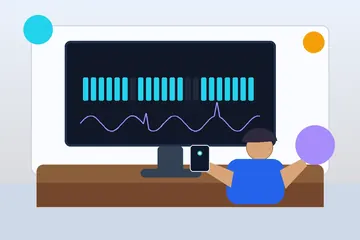
01 / 10Screen flicker testYour screen may be flickeringMany displays dim by switching the backlight on and off hundreds of times a second.02 / 10The symptomSore eyes and evening headachesStrain that gets worse at night, on one device but not another, is the clue.03 / 10What PWM meansDimming by blinking, not fadingInstead of lowering brightness, the backlight pulses. Faster pulsing is easier to tolerate.04 / 10Why night is worseLower brightness, deeper flickerThe dimmer you set the screen, the longer the backlight stays off between pulses.05 / 10Run the testWatch the moving patternA flickering backlight breaks the motion into separate copies instead of a smooth trail.06 / 10What to look forBands mean pulsingClear repeated edges suggest PWM. A smooth blur suggests steady, flicker-free dimming.07 / 10Not everyoneSome people never noticeSensitivity varies widely. Migraine and dry eyes can make the same screen unbearable.08 / 10What helpsRaise brightness, lower contrastHigher brightness usually shortens the off phase. Warm light and screen breaks help too.09 / 10One honest limitA browser cannot measure hertzThis shows whether flicker is visible to you, not the exact PWM frequency.10 / 10Your turnSee how your screen dimsRun the pattern at full and low brightness, then compare your devices.
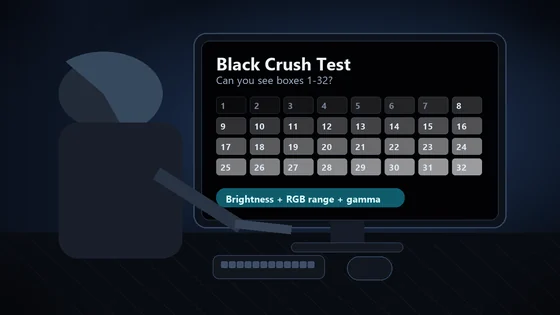
01 / 10Monitor checkDark scenes losing detail?Your monitor may be turning several near-black shades into one flat black.02 / 10The symptomShadow texture disappearsHair, clothing, caves and night scenes merge into featureless black. That is black crush.03 / 10Before you testUse normal SDR settingsDim the room, avoid glare and let your eyes adapt for 30 to 60 seconds.04 / 10The testLook for 32 near-black stepsPatch 1 is darkest. Patch 32 is easiest. Use fullscreen and do not expect the low steps to glow.05 / 10Read the resultFind the first visible patchIt should be barely separate from the black background. Note its number.06 / 10ExcellentYou can see 1 through 32Your display is preserving very dark shadow steps. Subtle is correct.07 / 10Mild crushingVisibility starts near 4Brightness may be too low, or gamma may be hiding the first few steps.08 / 10Moderate to severeVisibility starts at 8 or 16Check the monitor black-level setting and whether the GPU is sending Full or Limited RGB.09 / 10Fix one variable at a timeBrightness. Range. Gamma.Retest after each change. Establish a clean SDR result before troubleshooting HDR.10 / 10See what your display keepsRun all 32 shadow stepsThe live tool is the proper diagnostic surface; compressed story images are only a guide.