















Fast Answer
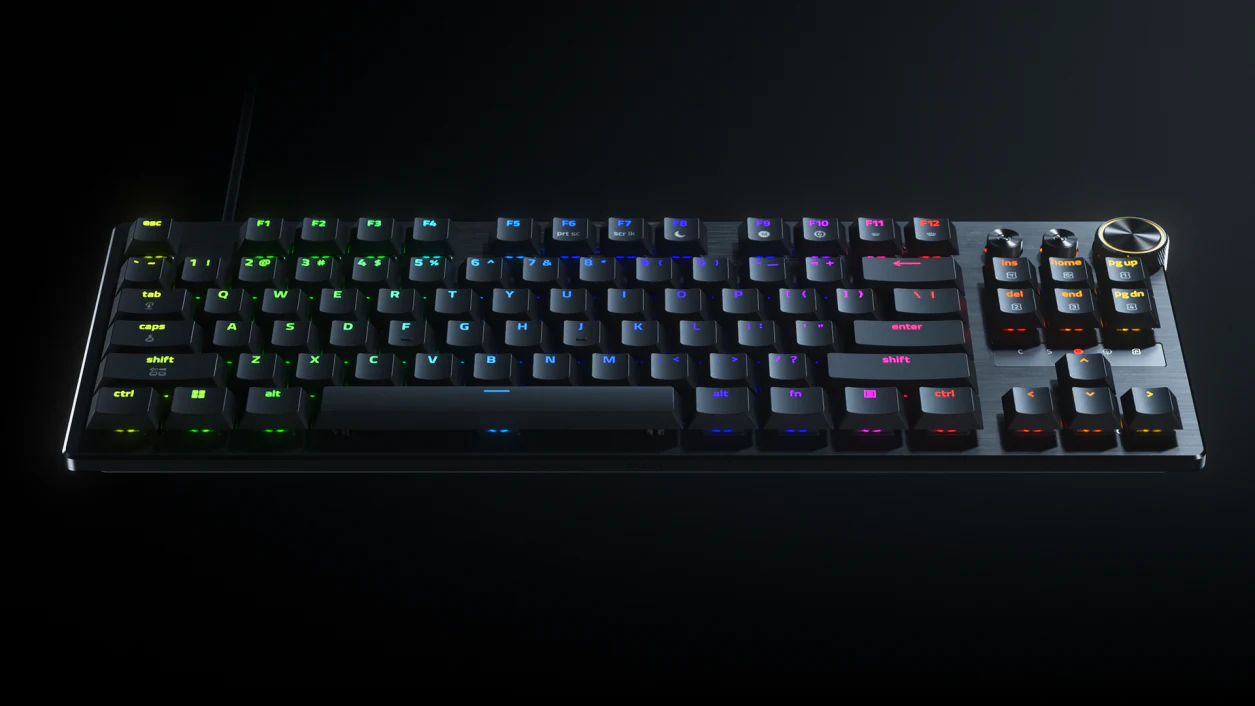
The Razer Huntsman V3 Pro Low-profile Tenkeyless 8KHz, support family RZ03-05850, moves Razer’s analog-optical controls into a board with a 19.5 mm front height, 2.8 mm total travel, and 0.1–2.8 mm adjustable actuation. At the official US prices checked August 24, it costs $10 more than the standard-height RZ03-0552. The strongest reason to buy is a genuine preference for low-profile geometry—not a proven speed win.
Disclosure: this is a source-based launch analysis. KeyboardTester.click did not receive, use, hear, or benchmark this keyboard.
Razer announced the model on August 20, 2026, and official stores in the United States, United Kingdom, Canada, and Australia offered it for purchase when this article was written. The name matters: Razer now sells several similarly named 8KHz Huntsman TKL boards with different switches, travel ranges, prices, and package contents.
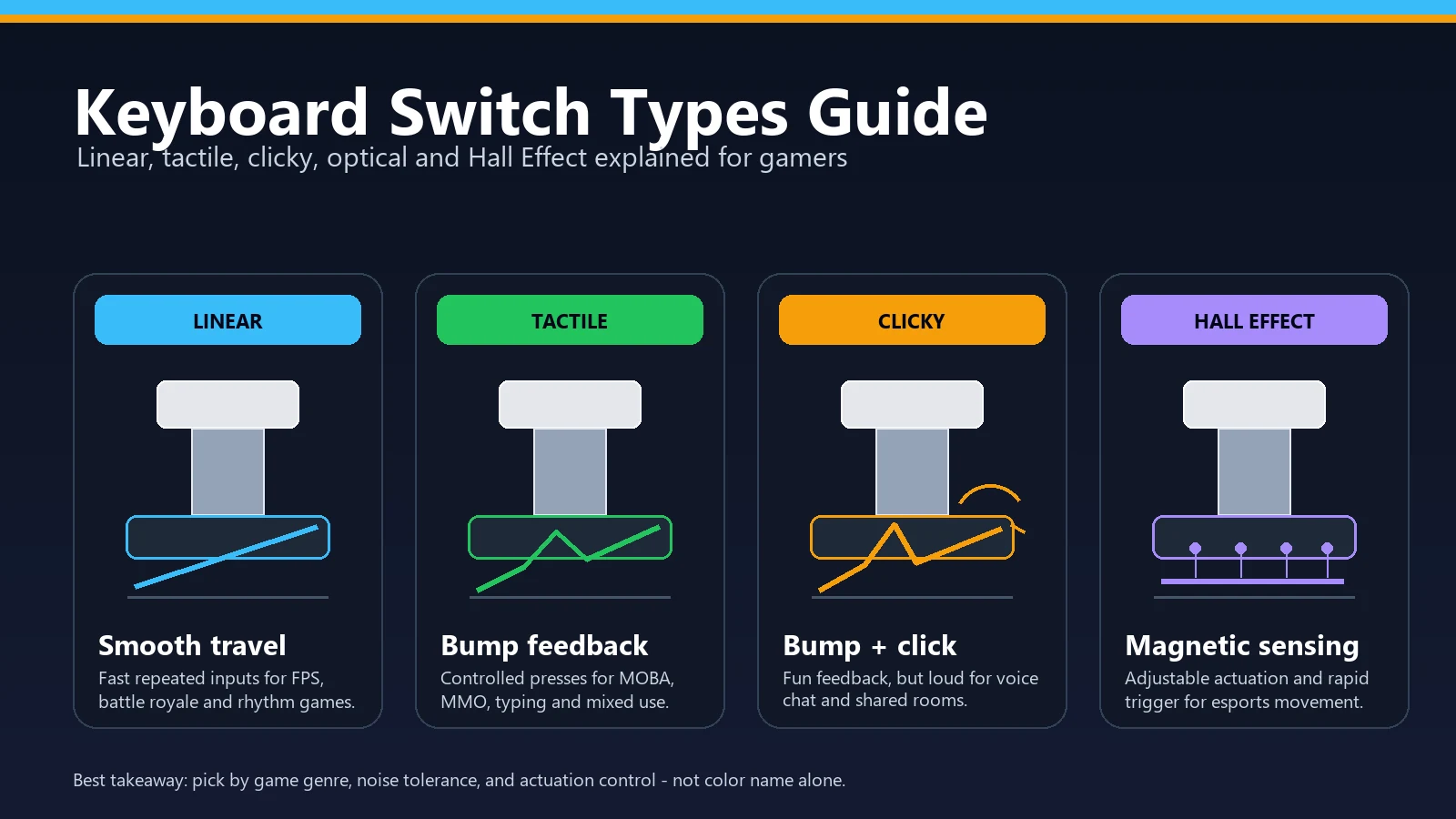
This guide isolates the exact low-profile model, compares it with the correct standard-height sibling, and gives you a reproducible return-window check. For wider context, see the current gaming-keyboard launch roundup and the optical, Hall Effect, and mechanical switch guide.
Official Product Video
This 48-second video is Razer’s own product presentation, not an independent review or KeyboardTester.click test.

Independent Hands-On Review Video
Kephren’s 8-minute 44-second video compares the exact low-profile model with the standard TKL, including real gaming, writing, and coding use. The creator marks it as not sponsored. It is an independent review, not a KeyboardTester.click test; the official Razer video above remains unchanged.

Identify the Exact Model First
The full name is Razer Huntsman V3 Pro Low-profile Tenkeyless 8KHz. Razer Support identifies it as RZ03-05850. The linked United States and Canada store SKU is RZ03-05850200-R3U1; the linked United Kingdom and Australia US-layout SKU is RZ03-05850100-R3M1.
Do not confuse it with the standard-height Huntsman V3 Pro Tenkeyless 8KHz, RZ03-0552; the non-Pro Huntsman V3 Tenkeyless 8KHz, RZ03-0575; or the Hall Effect Huntsman V3 HE Magnetic Tenkeyless 8KHz, RZ03-0592x. The HE Magnetic model guide covers that cheaper magnetic board separately.
US, UK, Canada, and Australia Prices
These are dated official-store observations, not currency conversions or permanent price promises. Each checked surface exposed an add-to-cart state on August 24, 2026.
| Market | Official price | Status checked Aug. 24 | Layout note |
|---|---|---|---|
| United States | US$229.99 | Add to cart; delivery options shown | US layout |
| United Kingdom | £229.00 | Add to cart | Linked SKU selected US layout; German and French choices also appeared |
| Canada | CA$319.99 | Add to cart; delivery options shown | US layout |
| Australia | AU$399.95 | Add to cart on the official keyboard listing | US layout listing |
Razer’s US page displayed “Risk Free Return,” and the current Razer warranty table lists two years for keyboards and keypads, subject to the seller, region, applicable law, and the terms in force when you purchase. Verify the exact layout, seller, delivery date, return period, and warranty in your cart before paying.
What Actually Changed?
The new board is not merely a shorter case around the same standard switch. Razer introduced a low-profile analog optical switch with a reduced travel envelope. That physical geometry is the meaningful change; Rapid Trigger, adjustable actuation, analog input, profile storage, and Razer’s 8KHz positioning already exist elsewhere in the Huntsman family.
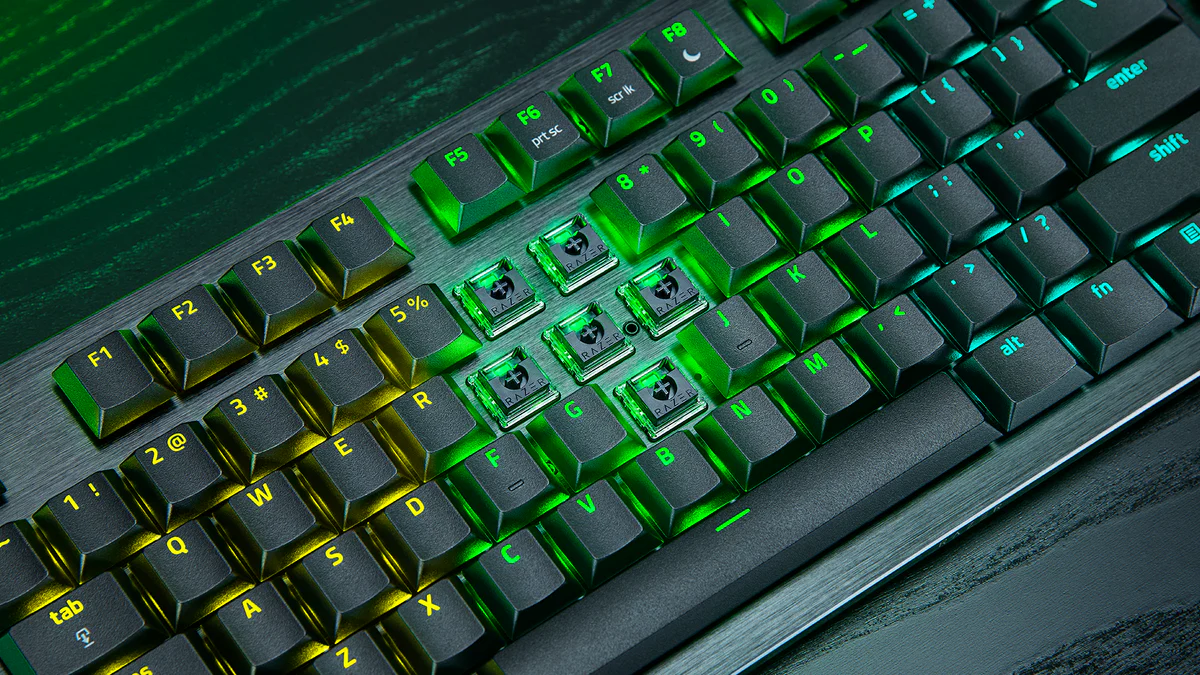
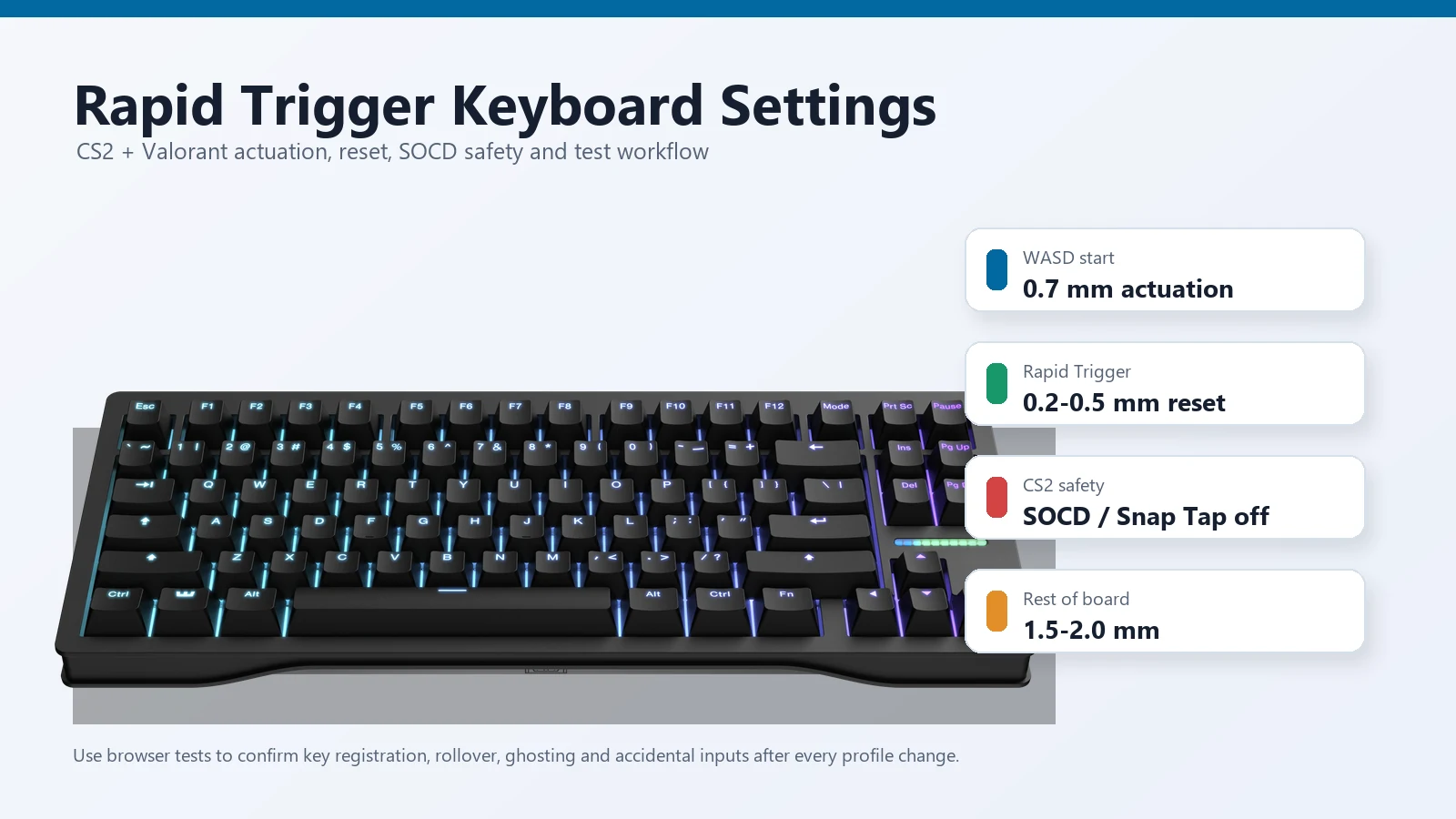
Razer also lists Snap Tap, Snap Flex, Dynamic Keystroke, Dual-Keypress Priority, Rapid Trigger, analog input, and quick onboard adjustment. Some input-priority or multi-action behavior may be restricted by a particular game, league, LAN, or tournament. Check the exact current rules before competition; a product feature list is not proof of legality.
Low-Profile RZ03-05850 vs Standard RZ03-0552
The closest fair comparison is the standard-height Huntsman V3 Pro Tenkeyless 8KHz, RZ03-0552. It is not the lower-cost non-Pro RZ03-0575 that appears in some roundups. The table compares official specifications and US prices checked August 24, not KBT hands-on performance.
| Decision point | Low-profile RZ03-05850 | Standard RZ03-0552 | What it means |
|---|---|---|---|
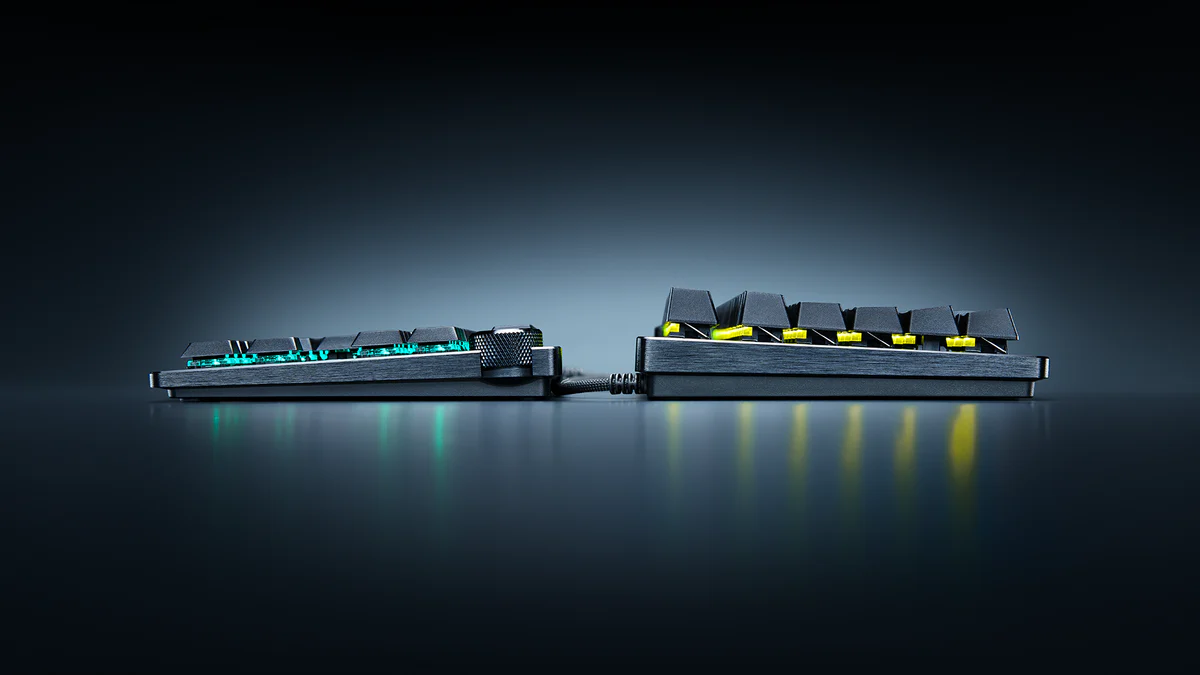
| Switch geometry | Low-profile analog optical | Standard-height analog optical Gen-2 | Desk height and travel are the real differentiators. |
| Adjustable actuation | 0.1–2.8 mm | 0.1–4.0 mm | The standard board offers a deeper maximum setting. |
| Total travel | 2.8 mm | Longer standard-height travel | Choose based on preferred key movement, not a universal “better” label. |
| Polling claim | Up to 8,000 Hz | Up to 8,000 Hz | 8K is not unique to the new board. |
| Media controls | Dial plus two dedicated buttons | Dial plus two dedicated buttons | No meaningful control loss on the new model. |
| Wrist rest | None listed | Magnetic firm leatherette rest listed | Package value differs even though the low front may reduce some buyers’ need for a rest. |
| US price checked Aug. 24 | US$229.99 | US$219.99 | The low-profile version cost $10 more. |
Where the HE Magnetic model fits: RZ03-0592x is a separate Hall Effect value choice with a taller 0.1–4.0 mm range. The new RZ03-05850 is the low-profile analog-optical choice. Neither sensor name alone proves better real-world speed, feel, firmware, or reliability.
What 8KHz, 0.39 ms, and “52% Faster” Really Mean
Razer’s footnote says the comparison used 20 measurements with keyboards set to 0.1 mm actuation. The endpoint was the host USB port, and Razer explicitly notes that end-to-end latency can vary with the setup and devices. Our input-latency chain guide explains why device, USB, operating system, game, frame queue, and display delay must be kept separate.
A browser cannot certify: true USB 8,000 Hz polling, internal matrix scan rate, a physical 0.1 mm actuation point, firmware timing, Razer’s 0.39 ms result, or end-to-end gaming latency. A held-key browser “Hz” value is heavily shaped by operating-system auto-repeat and browser event delivery.
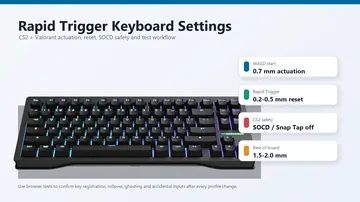
If you tune Rapid Trigger, begin with conservative settings and change one variable at a time. The Rapid Trigger setup and verification guide gives a safer baseline than copying an esports player’s configuration blindly. For the measurement boundary, see the browser keyboard-polling guide.
Who Should Buy, Keep the Standard Board, or Wait?
- You already know you prefer short travel and a lower front edge.
- You want analog actuation, Rapid Trigger, onboard controls, and a TKL layout.
- A wired-only keyboard and no included wrist rest are acceptable.
- The $10 US premium is small relative to your geometry preference.
- You prefer deeper travel or want settings up to 4.0 mm.
- You value the bundled magnetic wrist rest.
- You already own it and have stable profiles that work.
- You do not have a clear reason to pay again for low-profile geometry.
- You need wireless, hot-swappable switches, a number pad, or USB passthrough.
- You want independent latency data across identical setups.
- You are unsure whether 2.8 mm travel suits your typing.
- You cannot easily return an unsuitable layout or feel.
Our practical verdict on the $10 premium: it is reasonable for a buyer who actively wants low-profile geometry. It is not evidence that the new board is automatically faster, more comfortable, or better for everyone. If you are unsure, try a low-profile board locally or buy only with a workable return path.
Five Honest Tests to Run After Delivery
Use the factory profile first, connect directly to the computer, and save screenshots or notes. Then change one actuation or Rapid Trigger setting and repeat. This isolates browser-visible behavior before the return window closes; it does not replace electrical, firmware, or laboratory testing.
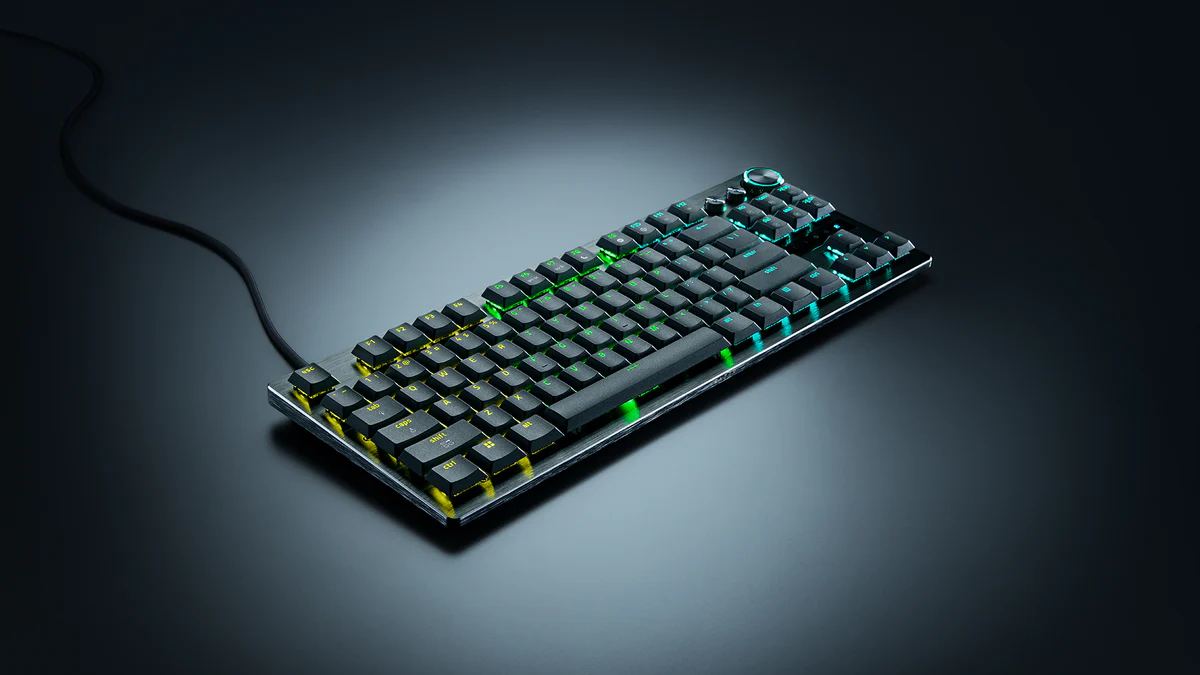
Watch for: a missing key, unexpected code, or a key that remains highlighted. Fn-layer, firmware-only, and OS-reserved actions may not reach the page.
Watch for: a repeatable dropped or phantom browser-visible key. Passing selected chords does not certify the entire matrix.
Watch for: two browser events from one intended press. The symptom alone cannot identify calibration, firmware, or hardware as the cause.
Watch for: profile-dependent changes or interruptions. This reflects OS/browser auto-repeat behavior, not raw USB 8KHz polling.
Watch for: accidental letters, missed releases, or a clear accuracy drop. This is a practical fit check, not a measurement of physical travel or latency.
A Secondary Polling-Page Check—with a Hard Limit
The keyboard event-timing page can show browser-visible held-key timing. Use it only to compare the same computer, browser, key, and settings. It cannot prove that the device is sending raw USB reports at 8,000 Hz.
Source-Based Verdict
The Huntsman V3 Pro Low-profile TKL 8KHz is a distinct, correctly identified Razer model—not a renamed standard board. Its defensible advantages are the lower front edge, shorter travel, full competitive-control set, onboard profiles, and current Synapse Web support.
The reasons to pause are equally concrete: a premium wired price, no included wrist rest, no hot-swap, no wireless mode, a shorter maximum actuation range than RZ03-0552, and no KeyboardTester.click hands-on evidence about comfort, feel, sound, firmware behavior, or latency.
Bottom line: buy for low-profile preference and test the retail unit carefully. Keep the standard board if you prefer deeper travel or already have stable settings. Do not buy because a browser supposedly confirmed Razer’s 8KHz or 0.39 ms claim—it cannot.
Sources and Evidence
Evidence disclosure: KeyboardTester.click did not receive a review sample and did not perform hands-on, acoustic, actuation-distance, USB-polling, firmware, durability, or end-to-end latency testing. Product identity, specifications, pricing, stock, images, and performance claims are attributed to Razer. Independent reviews are included for outside hands-on context only. Store facts were checked August 24, 2026 and can change.
- Razer launch announcement — August 20, 2026
Launch date, low-profile switch and travel figures, front height, advanced-input feature claims, press images, and Razer’s 8KHz/0.39 ms/52% test description. Accessed Aug. 24.
- Razer RZ03-05850 Support & FAQs
Exact family, technical specifications, dimensions, weight, package contents, profile count, controls, wrist-rest status, firmware, and warranty table. Updated Aug. 20; accessed Aug. 24.
- Razer Synapse Web supported-device list
Current inclusion of the RZ03-05850 exact model. Accessed Aug. 24.
- Razer US exact-model store page
US SKU, selected layout, US$229.99 price, add-to-cart state, delivery and return labels. Accessed Aug. 24.
- Razer UK exact-model store page
Linked SKU, £229.00 price, add-to-cart state, and listed layout choices. Accessed Aug. 24.
- Razer Canada exact-model store page
Canada SKU, CA$319.99 price, selected US layout, add-to-cart state, and delivery options. Accessed Aug. 24.
- Razer Australia keyboard listing
Exact US-layout listing, AU$399.95 price, and add-to-cart state. Accessed Aug. 24.
- Razer standard-height RZ03-0552 store page
Closest same-brand comparison and US$219.99 price snapshot. Accessed Aug. 24.
- Razer RZ03-0552 Support & FAQs
Standard-height actuation range, controls, wrist rest, software, firmware, and exact model identity. Accessed Aug. 24.
- Windows Central hands-on review
Independent two-week use, typing, design, package, and buyer-context reporting. Published Aug. 20; not used as the source for Razer’s official specifications.
- GamingTrend hands-on review
Independent launch-period use and target-buyer context. Published Aug. 19; not treated as KBT testing.
- Kephren exact-model comparison review
Independent 8-minute 44-second comparison with the standard TKL, covering real gaming, writing, and coding use. Published Aug. 20 and marked not sponsored; external opinions are not treated as KeyboardTester.click testing.
Razer Huntsman V3 Pro Low-Profile TKL FAQ
What is the Razer Huntsman V3 Pro Low-profile Tenkeyless 8KHz model number?
Razer Support identifies the model family as RZ03-05850. The US and Canada store SKU checked for this article was RZ03-05850200-R3U1, while the linked UK and Australia US-layout SKU was RZ03-05850100-R3M1.
What changed versus the standard Huntsman V3 Pro TKL 8KHz?
The RZ03-05850 uses new low-profile analog optical switches, a 19.5 mm front height, 2.8 mm total travel, and a 0.1–2.8 mm actuation range. The standard-height RZ03-0552 reaches 4.0 mm actuation and includes a wrist rest. Both carry Razer 8,000 Hz and competitive-input feature claims.
Is the $229.99 low-profile Razer keyboard worth the premium?
It is easiest to justify if you already prefer short-travel, low-front-height keyboards. On August 24, 2026, it cost $10 more than the standard-height RZ03-0552 in the US, so the buying case is geometry and preference rather than a proven KBT speed advantage.
Can a browser prove this Razer keyboard runs at 8,000 Hz or 0.39 ms?
No. Browser tools can observe key registration, practical chords, duplicates, held-key repeat behavior, and typing consistency. They cannot certify raw USB polling, internal scan rate, physical actuation distance, firmware timing, Razer’s host-USB latency result, or end-to-end gaming latency.
What should I test after the Huntsman V3 Pro Low-profile TKL arrives?
Test every browser-visible key, replay your real multi-key chords, look for duplicate events, compare held-key repeat behavior, and run a practical typing check. Save a factory-profile baseline and repeat each check after changing actuation, Rapid Trigger, profile, or firmware settings.
Start with a clean baseline: open the free Keyboard Tester, press every browser-visible key once on the factory profile, save what you observe, and repeat after each profile or firmware change.




Reader discussion
Comments
Share what worked, what did not, or what you would test next. Every comment is reviewed before it appears.
Loading approved comments…
Leave a comment
No account or sign-in is required. Links and HTML are not accepted.